Wellbeing Dashboard
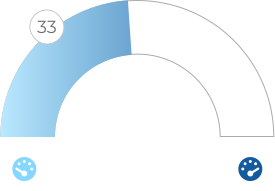
Activation
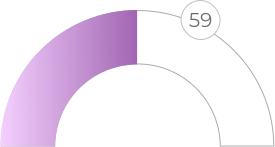
Wellbeing
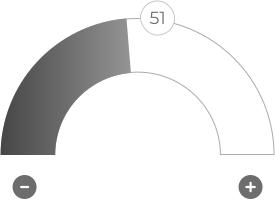
Positivity
 Global Benchmark
Pilot Program Baseline
Activation: 47
Wellbeing: 51
Positivity: 49
Sample Goals for the Program
Challenges at Community Colleges
Although we do not have specific data for this school, we reviewed studies that revealed community colleges in the United States are confronting significant challenges, notably high student dropout rates and low graduation rates. These issues are influenced by a variety of factors, including economic hardships, academic preparedness, and structural barriers within the educational system.
A substantial number of community college students discontinue their studies before completing their programs. Between 2020 and 2021, approximately 39% of full-time, first-year undergraduates at public two-year institutions dropped out. bestcolleges.com
Economic challenges play a pivotal role in these dropout rates. In 2023, 60% of students who had dropped out reported missing important bill payments, an increase from 49% in 2022. Additionally, 58% applied for public benefits in 2023, up from 49% the previous year. highereddive.com
Completion rates at community colleges remain concerningly low. Only 43% of students who began their studies in 2016 had completed a college program by 2022, marking the lowest completion rate across all sectors of higher education. This indicates that 57% of these students did not earn a degree or certificate within six years. newamerica.org
The likelihood of completion also varies significantly by race and ethnicity; for instance, only 31% of Black students who started in 2016 had completed a program by 2022, compared to over 50% of White and Asian students.
Contributing Factors
Several elements contribute to these challenges:
Economic Hardship
Many students face financial difficulties that impede their ability to continue their education. The increasing number of students missing bill payments and seeking public assistance underscores the economic pressures that can lead to higher dropout rates. highereddive.com
Academic Preparedness
A significant portion of community college students require remedial education. Studies have found that students placed into developmental courses often struggle to progress to college-level coursework, with failure and withdrawal rates in some courses approaching 70%. files.eric.ed.gov
Structural Barriers
Navigating the complexities of college systems can be daunting. Barriers such as complicated enrollment processes, limited access to advising, and balancing academic responsibilities with work and family obligations can hinder student success. brookings.edu
About AgileBrain®
AgileBrain® is a breakthrough approach to measure human emotions. Grounded in psychology and leveraging neuroscience, AgileBrain has been proven to capture unmet emotional needs with high accuracy and specificity. AgileBrain is the subject of 10+ peer-reviewed articles in leading psychology journals and has been extensively validated in multiple, large-scale user studies. AgileBrain is recognized by Buros Center for Testing, the leading catalogue of psychological assessments, and is fully-compliant with the American Psychological Association guidelines for valid assessment.
The secret to AgileBrain’s success is found in the what and the how it measures human emotions. The What is the AgileBrain Framework, an elegant distillation of 150 years of psychological theory (over 100 theories of motivation in all) into 4 domains of living (self, material, social and spiritual) and 3 levels of living (foundational, experiential and aspirational). The AgileBrain Framework makes it easy to understand and educate people – through AgileBrain exercises and lessons – thereby building their emotional awareness of and resiliency. The How are AgileBrain Exercises, quick (3-minute) image-selection activities that bypass cognitive bias to capture people’s subconscious, emotional needs within the AgileBrain Framework. AgileBrain captures the image selections and speed of selection and converts response data into digital form, literally converting emotions into data to support accurate measurement at the individual and group levels and at the current time and in over-time comparisons. These metrics include emotional Activation (a proxy for stress), emotional Positivity (a proxy for outlook) and an overall wellbeing. In addition, AgileBrain also calculates an emotional needs state (AgileBrain 10 State) that can provide more insight to support counseling.
Note: AgileBrain provides wellbeing information; it does not diagnose or recommend treatment for any mental illness.

Emotions ≠ Thoughts
AgileBrain targets emotions and not thoughts.

Images ≠ Words
AgileBrain shows images and not words.

Fast ≠ Slow
AgileBrain is very quick, the exercise is around 3 minutes.
AgileBrain® AI Coach

AgileBrain has just released its own AI-enabled coach, named “Dr. Bill,” to assist in interpreting AgileBrain results and in supporting the wellbeing journey. Dr. Bill’s chat interface is fed with the individual’s or group’s specific AgileBrain emotional needs metrics and informed and bounded by AgileBrain content to provide an exceptionally accurate and personalized emotional feedback experience.
Dr. Bill can be used in a variety of scenarios, including:
- By Counselors and Advisors – to speed preparation for and productivity during counseling sessions
- By Administrators – to identify unmet emotional need areas for improvement and best practices to leverage in their schools

Coming Soon, JD the Penguin, a student-facing chatbot!
For use by students, the JD chatbot is informed by the student’s inspo powered by AgileBrain results as well as AgileBrain content. This empowers each student to have a rich conversation with JD about their results to gain additional insights and actionable steps on their emotional wellbeing journey. If the student indicates distress or needs immediate help, JD will refer them to specific resources on campus and in the community.